
Open-Source LLMs in 2026: Comparing Llama 3.3, Mistral, Qwen 3, and Phi-4
About this translation
Original publication dates and historical context are preserved. Images, embedded media, source documents and code examples remain in their original language.
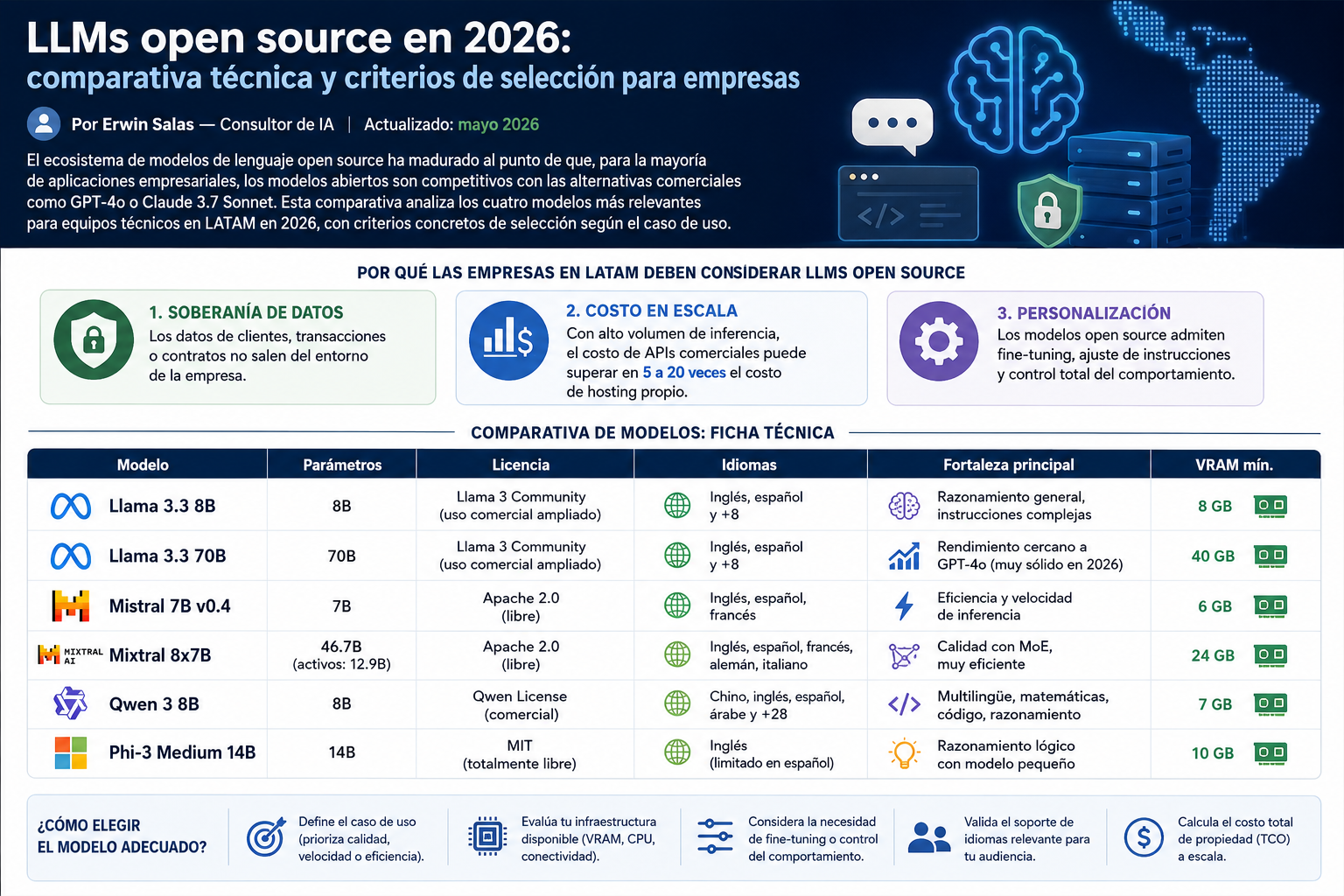
The open-source language model ecosystem has matured to the point where, for most business applications, open models compete with commercial alternatives such as GPT-4o or Claude 3.7 Sonnet. This comparison examines the four most relevant models for technical teams in LATAM in 2026, with concrete selection criteria for each use case.
Why companies in LATAM should consider open-source LLMs
Three practical reasons justify evaluating open-source models against commercial APIs in the Latin American business context:
- Data sovereignty: customer, transaction, and contract data never leaves the company's environment.
- Cost at scale: at high inference volumes, commercial API costs can be 5 to 20 times higher than self-hosting costs.
- Customization: open-source models support fine-tuning, instruction adjustment, and full control over behavior.
Model comparison: technical specifications
| Model | Parameters | License | Languages | Main strength | Min. VRAM |
| Llama 3.3 8B | 8B | Llama 3 Community (expanded commercial use) | English, Spanish, and 8+ more | General reasoning, complex instructions | 8 GB |
| Llama 3.3 70B | 70B | Llama 3 Community (expanded commercial use) | English, Spanish, and 8+ more | Performance close to GPT-4o (very strong in 2026) | 40 GB |
| Mistral 7B v0.4 | 7B | Apache 2.0 (free) | English, Spanish, French | Inference efficiency and speed | 6 GB |
| Mixtral 8x7B | 46.7B; active: 12.9B | Apache 2.0 (free) | English, Spanish, French, German, Italian | Quality with MoE, highly efficient | 24 GB |
| Qwen 3 8B | 8B | Qwen License (commercial) | Chinese, English, Spanish, Arabic, and 28+ more | Multilingual, mathematics, code, reasoning | 7 GB |
| Phi-3 Medium 14B | 14B | MIT (fully free) | English (limited Spanish) | Logical reasoning with a small model | 10 GB |
Analysis by business use case
Customer service and chatbots in Spanish
For this use case, Llama 3.3 8B and Qwen 3 8B are the strongest candidates. Both handle Latin American Spanish well, including regional variations. Qwen 2.5 outperforms Llama on mixed-language tasks or inputs combining Spanish with technical English.
Document analysis and extraction
Mixtral 8x7B and Llama 3.3 70B lead in long-document comprehension and structured extraction. For teams with limited resources, Mistral 7B with targeted fine-tuning can achieve comparable performance in clearly defined domains.
Code generation and automation
Phi-3 Medium 14B stands out unexpectedly here: despite being significantly smaller than Llama 70B, it performs competitively on code benchmarks (HumanEval, MBPP). Its MIT license makes it ideal for SaaS products without distribution restrictions.
Financial and legal applications
For applications with high regulatory sensitivity, Llama 3.3 fine-tuned on local financial documentation is the safest route. The Llama 3 Community license (expanded commercial use) permits commercial use with restrictions on user scale, so legal teams should review the terms before deployment.
Performance benchmarks: what they measure and how to interpret them
| Benchmark | What it measures | Leader (open source) |
| MMLU | General knowledge (57 subjects) | Llama 3.3 70B |
| HumanEval | Python code generation | Phi-3 Medium |
| MT-Bench | Multiturn conversation and reasoning | Mixtral 8x7B |
| HellaSwag | Common-sense understanding | Llama 3.3 70B |
| TruthfulQA | Reducing hallucinations | Mistral 7B (fine-tuned) |
| MGSM (Spanish) | Mathematics in Spanish | Qwen 3 8B |
Important: benchmarks measure performance under controlled conditions. In production, quality depends heavily on the prompt, context, and the model's level of domain specialization. A model with a lower benchmark score but targeted fine-tuning can outperform one with a higher benchmark score on the specific task.
Selection criteria: decision tree
- Is the data highly confidential? → Open-source models on your own infrastructure.
- Is the compute budget limited? → Fine-tuned 7–8B models (Llama 3.3 8B or Qwen 3 8B).
- Do you need maximum quality without VRAM restrictions? → Llama 3.3 70B or Mixtral 8x7B.
- Does the use case involve code generation or agents? → Phi-3 Medium or Llama 3.3 8B with function-calling tools.
- Do you need to distribute it as a product (SaaS)? → Models licensed under Apache 2.0 or MIT (Mistral, Phi-3).
Deployment infrastructure in 2026
The most widely used deployment options for open-source LLMs in business environments in 2026 are: Ollama (local, very mature, supports native GGUF quantization), vLLM (production, high throughput, the de facto standard for batch inference), LiteLLM (an abstraction layer for switching models without rewriting integrations), Hugging Face Inference Endpoints (managed cloud), and llama.cpp (CPU inference for environments without an available GPU).
Sources
- Hugging Face Open LLM Leaderboard (2026). huggingface.co/spaces/open-llm-leaderboard/about
- Meta AI. (2024). Llama 3 Model Card. ai.meta.com/llama
- Mistral AI. (2024). Mixtral of Experts. arxiv.org/abs/2401.04088
- Microsoft Research. (2024). Phi-3 Technical Report. arxiv.org/abs/2404.14219