
A Practical Guide to QLoRA: Fine-Tuning LLMs with Limited Resources
About this translation
Original publication dates and historical context are preserved. Images, embedded media, source documents and code examples remain in their original language.

Fine-tuning a large language model (LLM) used to require expensive GPU clusters. QLoRA (Quantized Low-Rank Adaptation) changed that equation: it allows models with up to 70B parameters to be tuned on a single consumer GPU. This guide explains how it works, when to use it, and how to run it in real enterprise projects.
What is QLoRA and why does it matter for businesses?
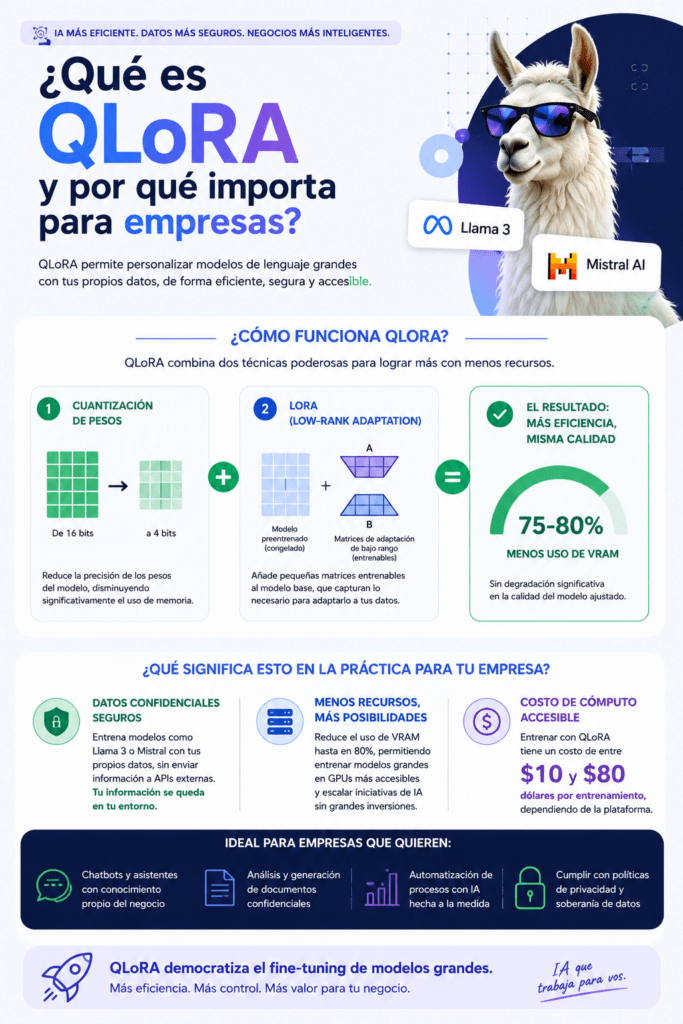
QLoRA combines two techniques: weight quantization (reducing the precision of model weights from 16 to 4 bits) and LoRA (Low-Rank Adaptation, which adds low-rank adaptation matrices to the base model). The result is a technique that reduces VRAM usage by 75-80% without significantly degrading the quality of the tuned model.
In practice, this means a company can customize a model such as Llama 3 or Mistral using its own confidential data without sending that information to external APIs, and with a compute cost of between $10 and $80 per training run, depending on the platform.
The difference between LoRA and QLoRA
| Feature | LoRA | QLoRA |
| Base model precision | 16-bit (FP16/BF16) | 4-bit (NF4) |
| VRAM required (7B model) | ~14 GB | ~6 GB |
| VRAM required (13B model) | ~26 GB | ~10 GB |
| Training speed | Faster | Somewhat slower |
| Output quality | High | High (comparable) |
| Cloud GPU cost | Medium-high | Low |
When to apply QLoRA in an enterprise project
QLoRA is the right technique when these conditions are met:
- Training data is confidential and cannot leave the company's infrastructure.
- The generic base model does not handle the vocabulary, jargon, or format expected by the business well.
- The infrastructure budget is limited (less than USD 500 per experiment).
- A model specialized in a specific task is needed: ticket classification, report generation, Q&A on internal documents.
Technical architecture: how it works internally
The QLoRA process has three core components that the technical team must understand before implementation:
1. NF4 Quantization (Normal Float 4-bit)
Base model weights are compressed to 4 bits using the NF4 format, designed specifically for LLM weight distributions (which are approximately Gaussian). Unlike integer quantization, NF4 better preserves information at the extremes of the distribution.
2. Double quantization
The quantization coefficients themselves are quantized again, saving an additional 0.37 to 0.5 bits per parameter, which allows even larger models to fit on the same GPU.
3. Trainable LoRA matrices in BF16
While the base model remains frozen at 4 bits, the low-rank adaptation matrices (LoRA) are trained at full BF16 precision. Only these matrices (representing less than 1% of total parameters) are updated during training.
Step-by-step implementation guide
Step 1: Prepare the dataset
The dataset must be in a conversational format (instruction-tuning format). Each example contains three fields: instruction (the task), input (optional context), and output (the expected response). The recommended minimum is 500 high-quality examples; more than 2,000 examples offers marginal improvements for specific tasks.
Step 2: Select the base model
For most Spanish-language enterprise use cases, the most effective candidates in 2025 are Llama 3.1 8B (Meta), Mistral 7B v0.3, and Qwen 2.5 7B (especially for LATAM languages and financial texts).
Step 3: Configure training parameters
| Parameter | Recommended value | Description |
| r (LoRA rank) | 16 — 64 | Adaptation capacity. Higher rank = more trainable parameters |
| lora_alpha | 32 — 128 | Scaling factor. Rule of thumb: 2x the value of r |
| lora_dropout | 0.05 — 0.1 | Regularization to avoid overfitting |
| learning_rate | 2e-4 | Standard learning rate for fine-tuning with LoRA |
| batch_size | 4 — 16 | Adjust according to available VRAM |
| num_epochs | 2 — 5 | More epochs increase the risk of overfitting |
| max_seq_length | 2048 | Maximum context length for each example |
Step 4: Training and monitoring
During training, the key metrics to monitor are training loss (it should decrease steadily), validation loss (if it rises while training loss falls, there is overfitting), and gradient norm (extremely high values indicate learning instability).
Step 5: Evaluation and merging
Once trained, the LoRA adapter is merged with the base model to generate a complete standalone model. Evaluation should use examples the model did not see during training and, where possible, human evaluators from the business domain.
The most common mistakes in enterprise QLoRA projects
- Low-quality dataset: 200 high-quality examples outperform 5,000 noisy examples.
- Excessive LoRA rank: r=256 rarely outperforms r=64 on specialized tasks, while increasing cost.
- Not using separate validation: without a validation set, the model may overfit without the team detecting it.
- Ignoring output quantization: the merged model must be re-quantized for efficient production inference.
Real case: fine-tuning for financial document processing
In a consulting project carried out with a leading Peruvian bank, QLoRA was applied to Mistral 7B to classify and summarize credit agreements. The dataset consisted of 1,200 anonymized agreements. Training took 4 hours on a Google Cloud A100 instance (approximate cost: USD 28). The resulting model outperformed the base model by 34% on key clause extraction, without any data leaving the banking environment.
Sources and references
- Dettmers, T. et al. (2023). QLoRA: Efficient Finetuning of Quantized LLMs. arXiv:2305.14314.
- Hu, E. et al. (2021). LoRA: Low-Rank Adaptation of Large Language Models. arXiv:2106.09685.
- Hugging Face PEFT Library Documentation (2025). huggingface.co/docs/peft
- Meta AI Research. (2024). Llama 3 Technical Report. ai.meta.com