
RAG for Business: How to Implement It Without Complex Infrastructure (2026)
About this translation
Original publication dates and historical context are preserved. Images, embedded media, source documents and code examples remain in their original language.
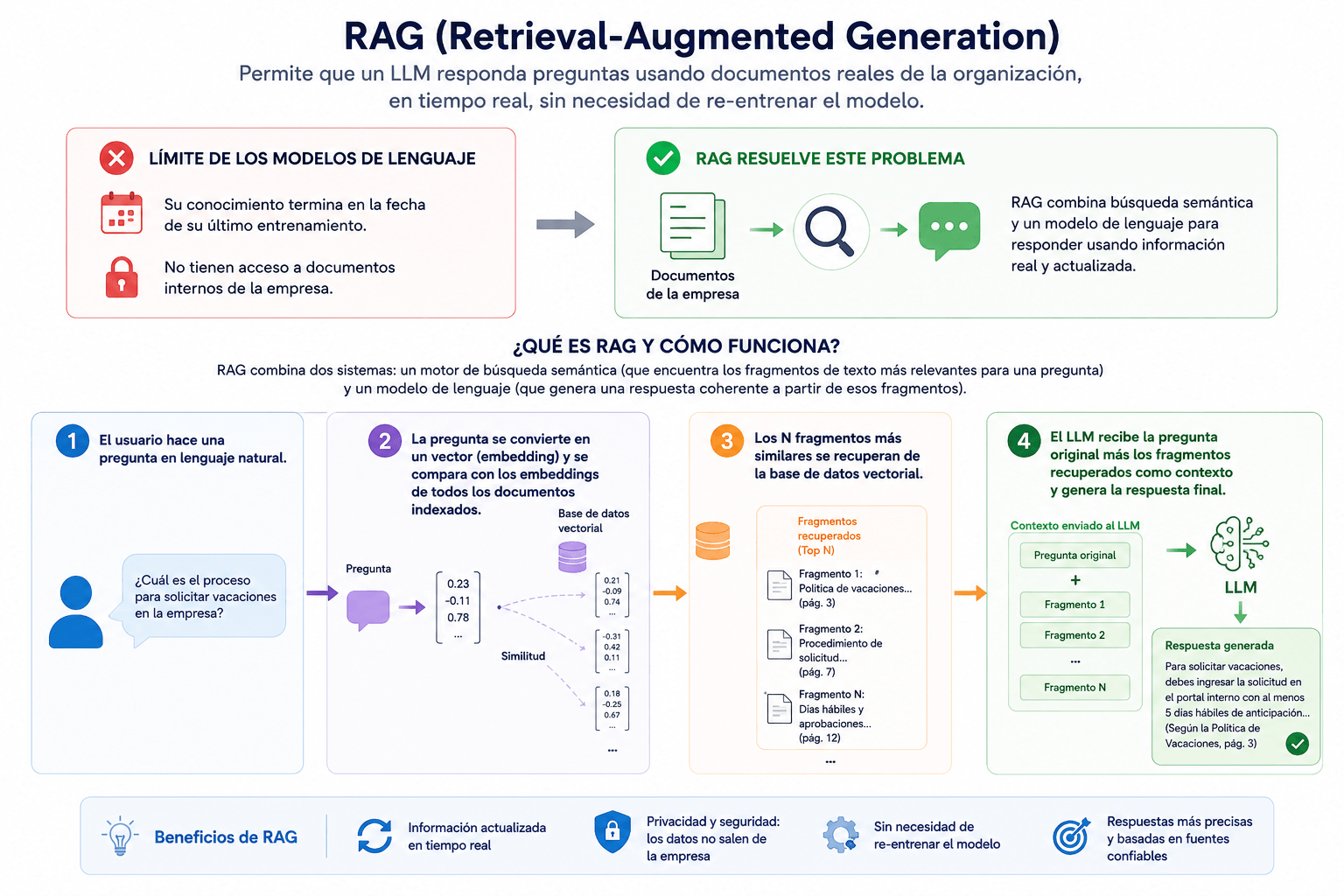
Language models have a known limitation: their knowledge ends at the date of their last training, and they cannot access internal company documents. RAG (Retrieval-Augmented Generation) solves precisely this problem: it allows an LLM to answer questions using the organization's real documents, in real time, without retraining the model.
What RAG is and how it works
RAG combines two systems: a semantic search engine (which finds the most relevant text passages for a question) and a language model (which generates a coherent answer from those passages). The full process has four steps:
- The user asks a question in natural language.
- The question is converted into a vector (embedding) and compared with the embeddings of all indexed documents.
- The N most similar passages are retrieved from the vector database.
- The LLM receives the original question plus the retrieved passages as context and generates the final answer.
When RAG is the right solution
| Situation | Is RAG the solution? |
| The team needs to consult internal manuals, policies, or contracts | Yes—an ideal RAG use case |
| The model needs to learn a distinctive writing style | No—use fine-tuning |
| Information changes frequently (prices, inventory, news) | Yes—RAG makes updating the index easy |
| Reasoning over structured data is needed (tables, databases) | Partially—combine with a SQL Agent |
| The document corpus exceeds 10 million tokens | Yes—RAG scales better than a long context window |
Reference architecture: RAG in production
Component 1: Document ingestion
Documents (PDFs, Word, HTML, emails) are processed with specialized parsers. Text is split into chunks of 256 to 1024 tokens with 10–20% overlap to preserve context between passages. Each chunk is enriched with metadata (source, date, department) that enables subsequent filtering.
Component 2: Vector database
Chunks are converted into vectors using an embedding model. The options most widely used in business environments are: ChromaDB (local, ideal for testing), Pinecone (managed cloud, high scale), Weaviate (open source, self-hosted), and pgvector (a PostgreSQL extension, ideal if the company already uses Postgres).
Component 3: Retrieval pipeline
Retrieval can be dense (embeddings only), hybrid (embeddings plus keyword-based BM25), or use re-ranking (a second model reorders results by relevance). A hybrid pipeline with re-ranking offers the best quality for business documents in Spanish.
Component 4: Augmented generation
The LLM receives a structured prompt containing behavioral instructions, the retrieved passages with their sources, and the user's question. The response should always include references to source documents to maintain traceability.
Recommended tools and stack for companies in LATAM
| Component | Budget option | Enterprise option |
| Document parsing | PyMuPDF + Docling (2026) | Azure Document Intelligence v4 |
| Embeddings | multilingual-e5-large or nomic-embed (free) | OpenAI text-embedding-3-large |
| Vector DB | ChromaDB or pgvector | Pinecone or Weaviate Cloud |
| LLM for generation | Local Llama 3.3 8B | GPT-4o, Claude 3.7 Sonnet, or Gemini 2.0 Flash |
| Orchestration | LangChain 0.3 or LlamaIndex 0.11 | LangGraph for complex workflows (2026) |
| User interface | Chainlit or Streamlit | Custom application with FastAPI |
Implementation in 5 weeks: project plan
Week 1: Assessment and corpus definition
Identify the documents the system needs to know, define priority use cases (who uses the system, and what questions do they ask?), and establish success metrics before writing the first line of code.
Week 2: Ingestion and chunking
Configure the ingestion pipeline, process the initial corpus, and validate chunking quality through manual review of a sample of 50 passages.
Week 3: Retrieval and evaluation
Build the vector index, implement retrieval, and measure accuracy with a set of 30–50 known questions (where the document containing the correct answer is known).
Week 4: Generation and prompt tuning
Integrate the LLM, adjust the system prompt for the expected tone and format, and begin testing with actual internal users.
Week 5: Deployment and monitoring
Launch in production with logging of all queries and answers, implement user feedback (thumbs up/down), and establish weekly reviews of the lowest-rated answers.
Real case: RAG for internal regulatory queries
In a 6-week project carried out in 2025 with a regulated financial institution, RAG was implemented over a corpus of 1,200 internal regulatory documents, SBS circulars, and procedure manuals. The system correctly answered 93% of test queries with full source traceability (hybrid pipeline with re-ranking). Response time for regulatory queries fell from 48 hours of manual searching to under 25 seconds.
Sources
- Lewis, P. et al. (2020). Retrieval-Augmented Generation for Knowledge-Intensive NLP Tasks. arXiv:2005.11401.
- Gao, Y. et al. (2023–2024). Retrieval-Augmented Generation for Large Language Models: A Survey (v3). arXiv:2312.10997. [Widely cited; more than 3,000 academic citations as of May 2026]
- LangChain Documentation. (2026). RAG from Scratch. python.langchain.com