
How to Use Claude Opus as the Brain and Sonnet as the Executor
About this translation
Original publication dates and historical context are preserved. Images, embedded media, source documents and code examples remain in their original language.
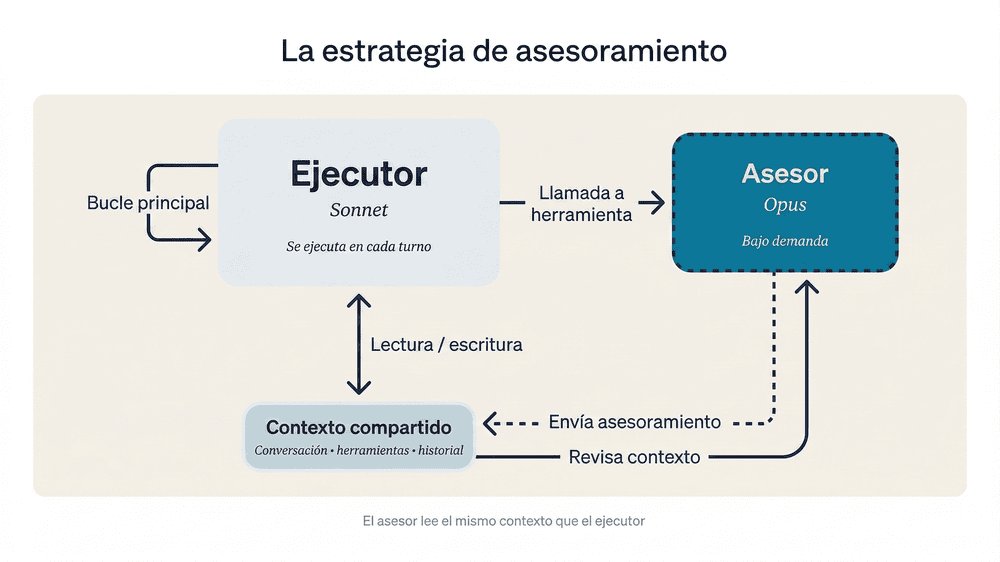
What is it and what is it for?
If you use Claude and run out of credits, this configuration will help you a lot. The idea is simple: instead of using Opus for everything (expensive), or Sonnet for everything (sometimes insufficient), you combine them in different roles:
| Role | Model | Function |
|---|---|---|
| Executor | Sonnet / Haiku | Does the complete job: calls tools, iterates, produces output |
| Advisor | Opus | Only steps in when the executor gets stuck — provides a plan, a correction, or a stop signal |
The executor drives. The advisor is the senior consultant who only steps in when there is a difficult decision.
How do you configure it?
It is literally one additional line in the API call. In the tools block of your call to /v1/messages, add the advisor like this:
type: "advisor_20260301"
model: "claude-opus-4-6"
max_uses: 3   ← cuántas veces puede consultar a Opus en esa llamada
The max_uses is the cost control: if the executor makes a lot of mistakes, it does not escalate indefinitely.
Why does it matter financially?
Opus only generates the short plan (typically 400-700 tokens). Sonnet handles all the long output at Sonnet's price. Tokens are billed separately by tier, allowing you to track spending precisely.
Anthropic's benchmarks show:
- Sonnet alone vs. Sonnet with an Opus advisor: 2.7 percentage points better on SWE-bench, 11.9% lower cost per task
- Haiku with an Opus advisor: 41.2% on BrowseComp vs. 19.7% alone — more than double the performance at a fraction of Sonnet's cost
How do YOU use it without code?
If you work with no-code tools or with someone who implements things for you, the key message is:
“Configure the API call with
advisor_20260301pointing to Opus as the advisor for a Sonnet executor, withmax_uses: 3«
That is all you need to tell the developer. The handoff between models happens within a single request — it does not require additional orchestration, extra logic, or multiple calls.
The analogy for your executive clients
It is like having a senior analyst who works all day (Sonnet), with the ability to call the Director (Opus) only when there is a strategic decision they cannot resolve alone. You do not hire the Director full-time — you only pay for their minutes of advice.
How can I use it in Claude.ai?
You can manually simulate the advisor logic in the web chat quite effectively:
Option 1 — Two conversations in parallel Open two tabs: one with Sonnet (executor) and another with Opus (advisor). When Sonnet gives you a response you are not convinced by, take that output to Opus for critique or improvement.
Option 2 — A single chat with explicit roles In a single chat with Opus, structure the prompt like this:
“First act as the executor: solve [task]. Then act as the advisor: review your own solution and correct it if there is a reasoning error.”
It is not the same as the API integration, but it captures the spirit of the pattern.
The real difference
| Claude Web/Desktop | API with Advisor Tool | |
|---|---|---|
| Model control | ❌ Fixed | ✅ You choose the executor and advisor |
| Automation | ❌ Manual | ✅ Happens within the same request |
| Optimized cost | ❌ You pay whatever it costs | ✅ Tokens separated by tier |
| For production | ❌ No | ✅ Yes |
What do you think of this hack?