ChatGPT Ads: How It Works, Costs and a Guide for Latin America
ChatGPT Ads lets businesses display advertising inside ChatGPT, separate from the assistant’s answer and selected for its relevance to the conversation.
Campaigns are managed in Ads Manager. For a Peruvian business, the opportunity is to connect a specific need with an offer that can actually meet it.
Imagine someone asking how to manage inventory across a physical shop and an online store. The conversation may clarify how many products they carry, their problems and what they need to compare.
An inventory software ad makes sense in that context if its offer fits the problem. That relationship between need, ad and solution is the starting point for this guide.
Information checked against OpenAI’s official documentation on November 3, 2026. Ads Manager continues to evolve: confirm eligibility, currencies and available options in your account before spending.
Source: how ads in ChatGPT work.
What to know before spending
- How it works: connects conversational context with a relevant offer.
- From Peru: you can open an eligible account; available destinations depend on your account.
- How much to allocate: distinguish budget, spending limit and cost per result.
- What to test: one need, one message and a page that enables measurement.
Guide contents
- What it is and where it appears
- Keywords, prompts and context hints
- Availability in Peru and Latin America
- How much ChatGPT Ads costs
- Budget calculator
- Which sectors to consider
- How to set up a campaign
- Setup example
- Headline generator
- What is allowed and restricted
- How to measure results
- Relationship with SEO and GEO
- Frequently asked questions
What it is and where it appears
- Ads appear below the answer, labeled as advertising and linking to the advertiser’s website.
- They can include the brand name, headline, description and an image.
- Paying for an ad does not buy a recommendation within the answer: OpenAI keeps advertising separate from the assistant’s response.
- The advertising experience is aimed at eligible Free and Go users.
- Plus, Pro, Business, Enterprise and Edu plans do not include ads.
- Ads are also not shown to accounts identified as belonging to users under 18.
- Rollout is gradual; allowing advertising accounts in a country does not mean every user there sees ads.
- Advertisers do not receive users’ private conversation history or memories.
- They receive performance information.
- Personalization may use additional signals when enabled by the user, but this does not turn conversations into a database accessible to the brand.
Source: advertising experience and privacy.
OpenAI principles: answer independence and conversation privacy.
Keywords, prompts and context hints
The main mechanism is contextual relevance. The system considers the conversation and intent alongside the ad and its landing page. This makes it useful to explain what you sell, who it helps and which need it addresses.
- Context hints are additional information supplied by the advertiser at ad-group level.
- They use natural language: features, use cases, actual prices or service conditions.
- They do not amount to buying an exact prompt, and they do not guarantee that an ad will appear for a specific question.
Inventory software for shops selling in person and online. It supports stock checks by size and color and product registration using barcodes.
This is a hypothetical example: you would only use those features if your product provides them. A list such as “inventory, stock, ERP, best software” provides less context. I would not write “show me only in Peru” as an instruction either: location belongs in campaign controls.
Source: official guidance on context hints.
Some eligible advertisers can use negative phrases. This is a specific platform feature; adding “do not show to…” inside hints does not create an exclusion. Ad selection also depends on the auction, which combines bids and relevance.
Source: relevance, auction and negative-phrase availability.
Availability in Peru and Latin America
Peru is listed among countries with self-service access to Ads Manager. Latin American markets also include Argentina, Bolivia, Brazil, Chile, Colombia, Costa Rica, Ecuador, El Salvador, Guatemala, Mexico, Panama, Paraguay, the Dominican Republic and Uruguay. Puerto Rico is included as a territory on the official list.
- The requirement applies to the legal entity advertising and being billed.
- Distinguish three things: being able to create an account, being able to select a destination, and having eligible users and ad inventory in that destination.
Source: countries supported by Ads Manager.
Some new accounts can initially advertise only in their home country. Expansion depends on approved identity verification and the required advertising spend in that market. Creating a campaign or assigning a budget alone does not unlock other countries.
Source: eligibility for international targeting.
- For a business operating from Peru, I would start with the market it can already serve well.
- Mexico, Colombia and Chile could be included in a second test if payment, support and delivery are ready.
- Brazil also requires Portuguese adaptation.
- This is an operational decision; no public ranking guarantees a higher return by country.
How much ChatGPT Ads costs
- ChatGPT Ads has no single price per ad.
- Views campaigns charge per thousand impressions (CPM), while Clicks campaigns charge per valid click (CPC).
- Conversion campaigns optimize toward a selected action but bill by clicks or impressions: you do not pay only when a sale happens.
Source: conversion-optimized campaigns.
These are selected published daily minimums, based on the account’s billing currency. They are neither exchange rates nor estimates of customer acquisition cost.
| Account currency | Daily minimum |
|---|---|
| PEN · Peruvian sol | S/ 13 |
| MXN · Mexican peso | MX$ 150 |
| BRL · Brazilian real | R$ 40 |
| CLP · Chilean peso | CLP 3,750 |
| COP · Colombian peso | COP 10,000 |
| USD · US dollar | US$ 25 |
Source: campaign minimums table.
- The daily budget works as a weekly average.
- Spending may reach twice the daily amount on one day and seven times that amount over the applicable week, with adjustments if you change it.
- The card billing threshold is different: it determines when you are charged, not how much you authorize the campaign to spend.
Source: billing, charges and budget.
Official details: budget weeks and daily-budget adjustments.
In a hypothetical test with S/ 50 per day, allow for up to S/ 100 on a single day and S/ 350 over a full week with no budget changes.
Include creative work, the landing page and measurement in your assessment. The technical minimum lets you start; business economics determine how much you should invest.
Official guidance mentions US$ 3–5 as a starting point for a manual CPC bid. This is a setup recommendation in dollars, not an observed average CPC or a cost promise for Peru. Do not automatically transfer that number into soles.
Source: guidance on manual bids.
TRY YOUR SCENARIO
ChatGPT Ads budget calculator
Change the values to compare how much you would allocate to a test. CPC and conversion rate are your assumptions; initial values only illustrate the calculation.
Calculation and scope
- Planned budget = daily × 7 × weeks. Clicks = budget ÷ CPC. Inquiries = clicks × conversion rate. Full budget use is assumed.
- Daily limit is 2× and weekly limit is 7× for full Sunday–Saturday weeks, with no budget changes, in the account timezone.
- Excludes taxes, production, landing pages and service fees. Does not estimate auction bids, sales or profitability. Check minimums and bidding restrictions in your account.
Which sectors to consider
I would evaluate businesses where people need to explain their situation before choosing. The following are hypotheses for testing, subject to policies and each ad’s approval; they are not an OpenAI performance ranking.
| Sector | Need that may connect with an ad | What to measure |
|---|---|---|
| Software and B2B SaaS | Organizing inventory, sales or projects | Qualified demos and customers |
| Education and training | Learning a skill for a work-related goal | Useful inquiries and enrollments |
| E-commerce | Comparing products by use and budget | Purchases and margin after advertising |
| Travel and experiences | Choosing an activity with specific requirements | Bookings and cancellations |
| Home and unregulated B2B services | Solving a need with a defined scope | Qualified quotes and contracts |
The criteria are straightforward: a recognizable problem, a verifiable offer, sufficient margin and the capacity to deliver. If the team takes three days to answer an inquiry, improve that process before increasing spending.
Source: frequently asked questions and limitations of available benchmarks.
How to set up a campaign
1. Prepare the account and destination
- Open Ads Manager and register the business using its actual details.
- Check country, currency and time zone: the documentation says these choices cannot be changed after account setup.
- Complete billing and verification when required.
2. Define a coherent campaign and ad group
- The structure is account → campaign → ad group → ad.
- Choose the objective according to the action you want.
- Separate products or needs that require different messages and landing pages.
- At group level, add useful hints and a bidding strategy available for your objective.
Source: ad groups and context.
When available, Maximize results automatically adjusts bids to pursue results within the budget. This automation does not guarantee an acquisition cost or return. A manual bid requires checking its amount and currency separately.
Source: Maximize results bidding strategy.
3. Create the ad and review before activation
- Write a specific benefit and link to the page that demonstrates it.
- You can use a single image or, if available in your account, a multi-image format.
- The guidance describes four to six square images for the multi-image format.
- Confirm that the destination loads and allows access by OAI-AdsBot and OAI-SearchBot.
Source: ad creation and asset requirements.
- Check the eligible country, objective, budget, billing, destination and ad status.
- Ad review and account readiness are separate checks.
- An approved ad may still fail to deliver if another requirement is missing.
Source: launching your first campaign.
Setup example
What the campaign panel looks like
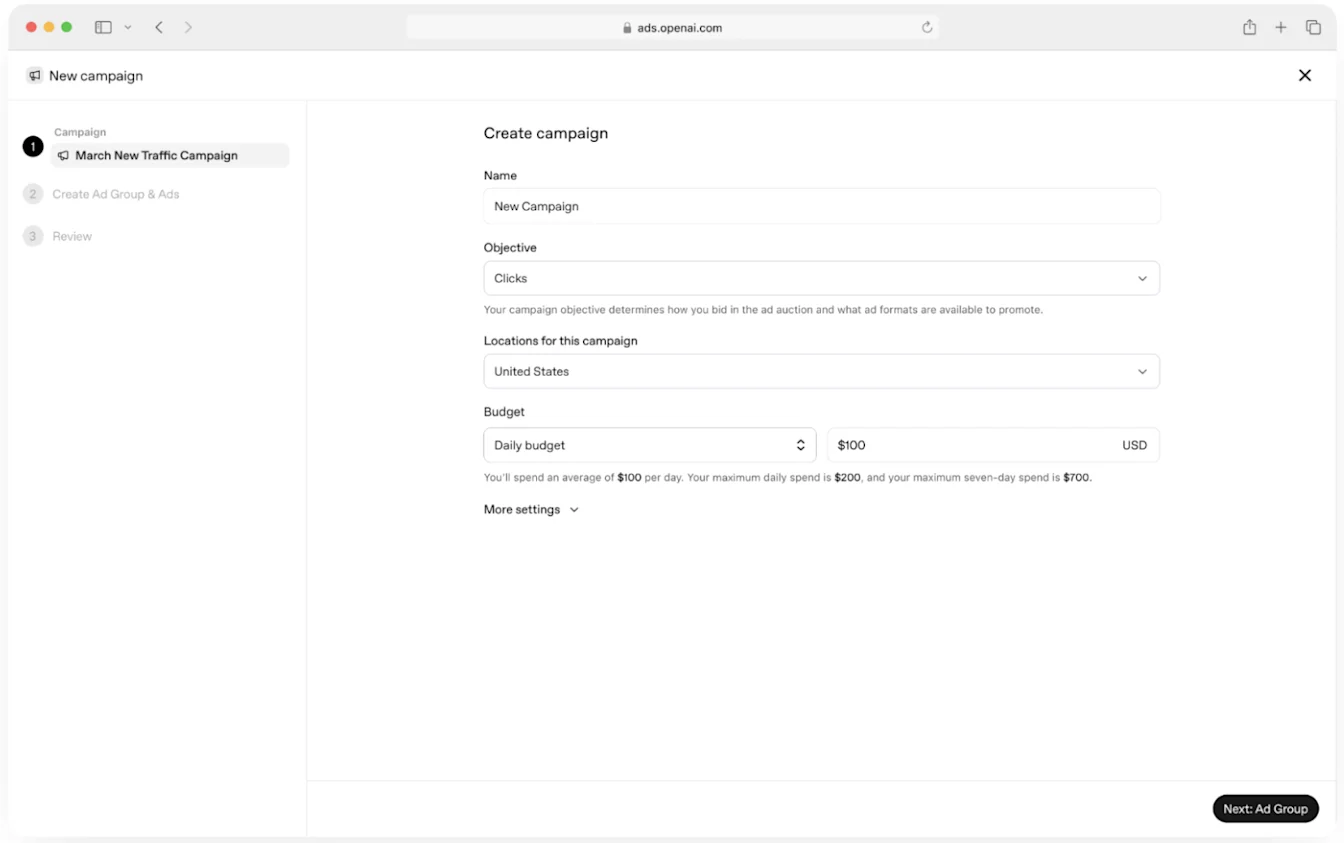
- Name: internal label to identify your test.
- Objective: the result the campaign pursues.
- Locations: eligible destinations where it can appear.
- Budget: the budget and spending limits shown in the panel.
Apply it to an example in Peru
Suppose a fictional company called RutaStock offers inventory software. The following screen is a teaching diagram of fields, not an official Ads Manager screenshot or a published campaign.
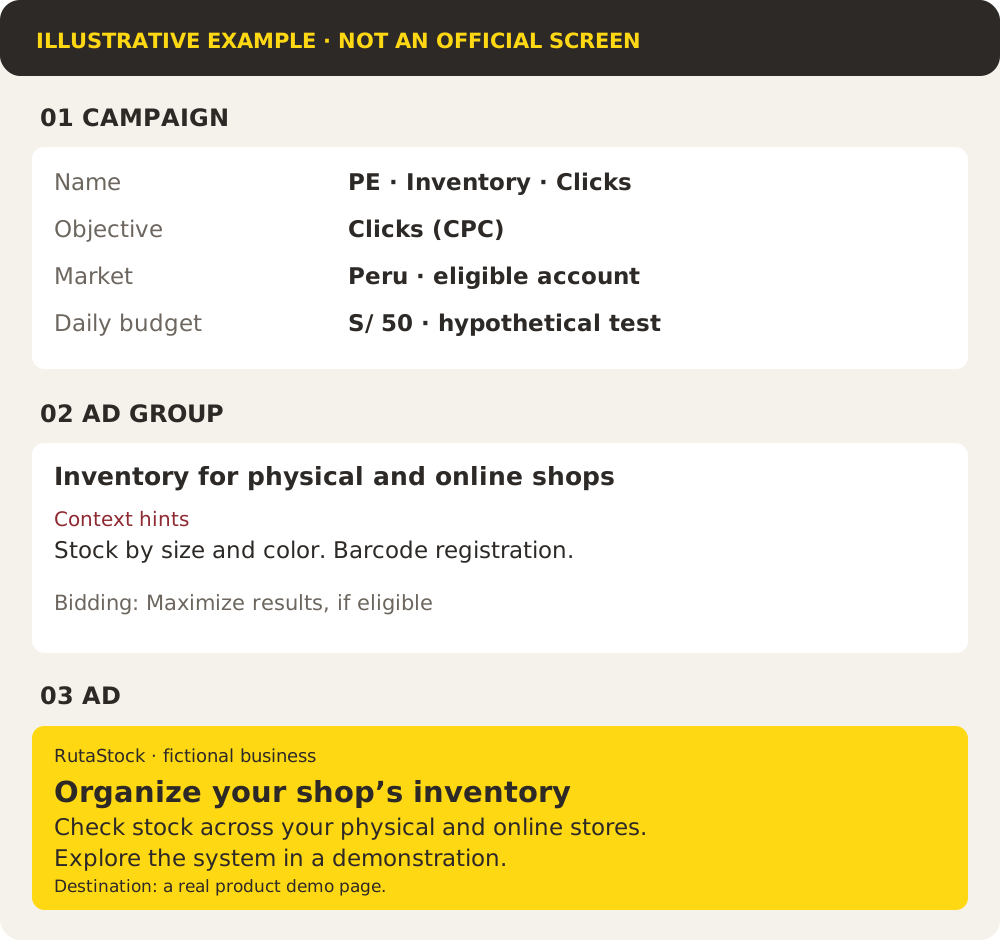
A clicks campaign helps observe visits and their quality. To optimize demo requests, I would set up the relevant measurement and an eligible conversion campaign. The landing page should show the product, its conditions and a simple form. Avoid sending every visitor to a generic homepage.
Read the example fields as text
- Campaign: PE · Inventory · Clicks.
- Objective: Clicks (CPC). Market: Peru, with an eligible account.
- Budget: S/ 50 daily as a hypothetical test.
- Group: inventory for physical and online shops.
- Context hints: stock by size and color; barcode registration.
- Bidding: Maximize results, if available.
- Headline: Organize your shop’s inventory.
- Description: Check stock across your physical and online stores. Explore the system in a demonstration.
- Destination: the actual product demo page.
I would test messages representing distinct decisions: controlling stockouts, connecting the physical and online stores or reducing manual work. Changing only an adjective provides little learning. I would keep relevant conditions consistent to understand which message produces better inquiries.
FROM PRODUCT TO MESSAGE
ChatGPT Ads headline generator
Describe a real offer. Get four drafts with different approaches to edit and check against your landing page.
An Erwin Salas template tool: it does not use the ChatGPT API. Inputs are processed on this page. Character counts are informational; check the available limit in Ads Manager.
What is allowed and restricted
- Policy depends on both product and country.
- Outside the United States, guidance restricts certain financial services and disallows categories such as cryptocurrency, personal loans, payments or remittances and financial planning.
- Legal services are limited to licensed providers in the United States.
- Health and medicines have additional restrictions; do not assume that a clinic or supplement can advertise in Peru because another sector has access.
Software supporting financial or healthcare operations may be treated differently from the regulated service itself. It must still comply with applicable policies. Review the exact category, ad claims and landing-page offer. This summary does not replace the full restrictions list.
Source: restrictions by category and market.
Ad policies: general requirements, content and destinations.
OpenAI also excludes political ads and avoids showing advertising alongside certain sensitive topics, such as health and mental health. Business eligibility and conversation eligibility are different assessments.
Source: limits of the advertising experience.
How to measure results
Start with impressions, clicks, spending and conversions; then connect those figures to qualified inquiries, customers and margin. CTR is clicks divided by impressions. CPC is spending divided by clicks. Neither metric alone demonstrates profitability.
- Reports do not all update at the same speed.
- OpenAI lists approximately 15 minutes for impressions, clicks and CTR, 7–8 hours for costs and 24–48 hours for conversions.
- Avoid judging a campaign using incomplete data.
- Sales and ROAS depend on supported purchase events.
Source: metrics and reporting delays.
- Conversion optimization requires OpenAI Pixel and/or the Conversions API with a supported standard event.
- Also tag the link with UTM parameters to identify the campaign in your analytics.
- UTMs help attribute visits; they do not replace the event reporting required for optimization.
Source: conversion optimization requirements.
Technical measurement documentation for OpenAI Ads.
A hypothetical calculation: S/ 300 in spending and ten inquiries equals S/ 30 per inquiry. If two become customers, advertising cost per customer is S/ 150.
Sales, service and production costs must then be deducted to assess margin. These figures explain the calculation; they do not forecast platform results.
Relationship with SEO and GEO
ChatGPT Ads adds a paid channel. SEO and GEO address organic visibility and content understanding. Running a campaign does not guarantee an AI citation of your website.
A useful recommendation is to maintain a consistent offer across the ad and accessible pages with an author, dates, evidence and clear answers.
The commercial opportunity requires looking at the whole system: conversation, ad, page, customer response and sale. Improving one part helps; coordinating all five lets you learn what works and where value is lost.
Frequently asked questions
Can I advertise with ChatGPT Ads from Peru?
Yes. Peru is on the official self-service list. The business must meet account, billing and policy requirements. The destinations it can advertise in depend on its eligibility.
How much do I need to start?
The official table lists S/ 13 as the minimum daily budget for accounts billed in PEN. A useful test budget depends on the goal and business; that minimum does not guarantee clicks, sales or a customer acquisition cost.
Do advertisers buy keywords or prompts?
The main mechanism uses context and relevance. Hints describe the product and its use cases; they are not bids on an exact prompt or instructions to control the assistant’s answer.
Does paying make ChatGPT recommend my brand?
No. Advertising is labeled and kept separate from the answer. Buying ad space does not buy an organic recommendation.
If you are considering this channel for your business, let’s discuss your offer, measurement and an initial test. Starting with a specific business question helps decide what to learn before deciding how much to scale.