
AI Agents for B2B Companies: Real Cases and How to Implement Them in 2026
About this translation
Original publication dates and historical context are preserved. Images, embedded media, source documents and code examples remain in their original language.
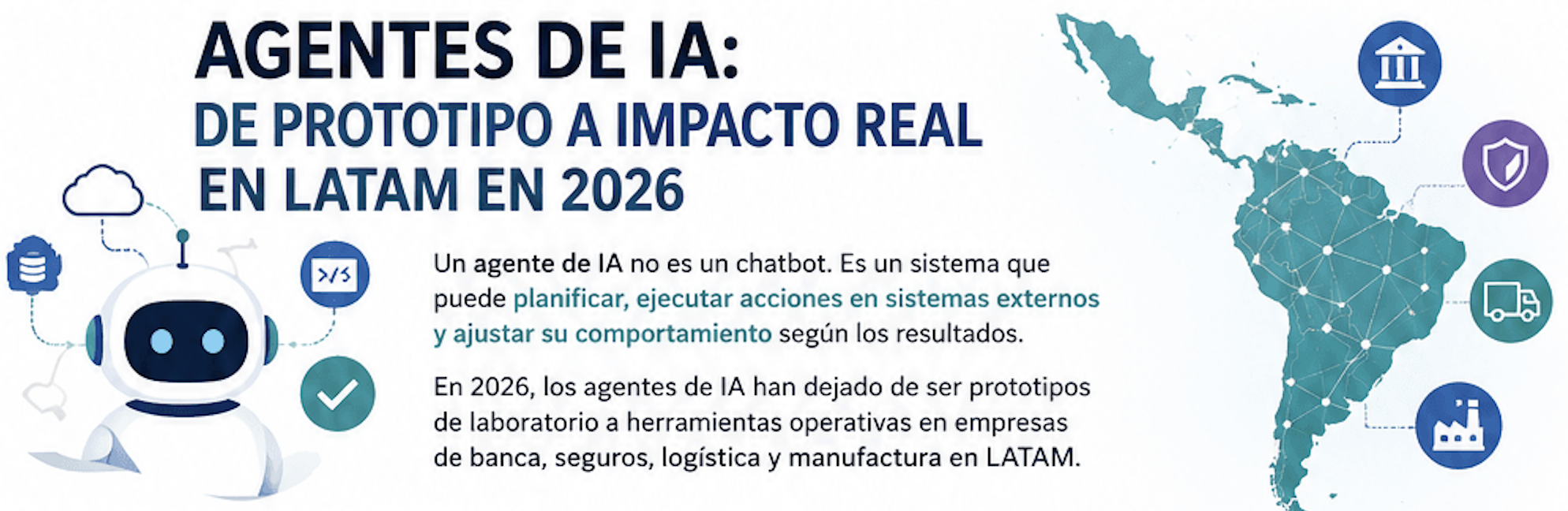
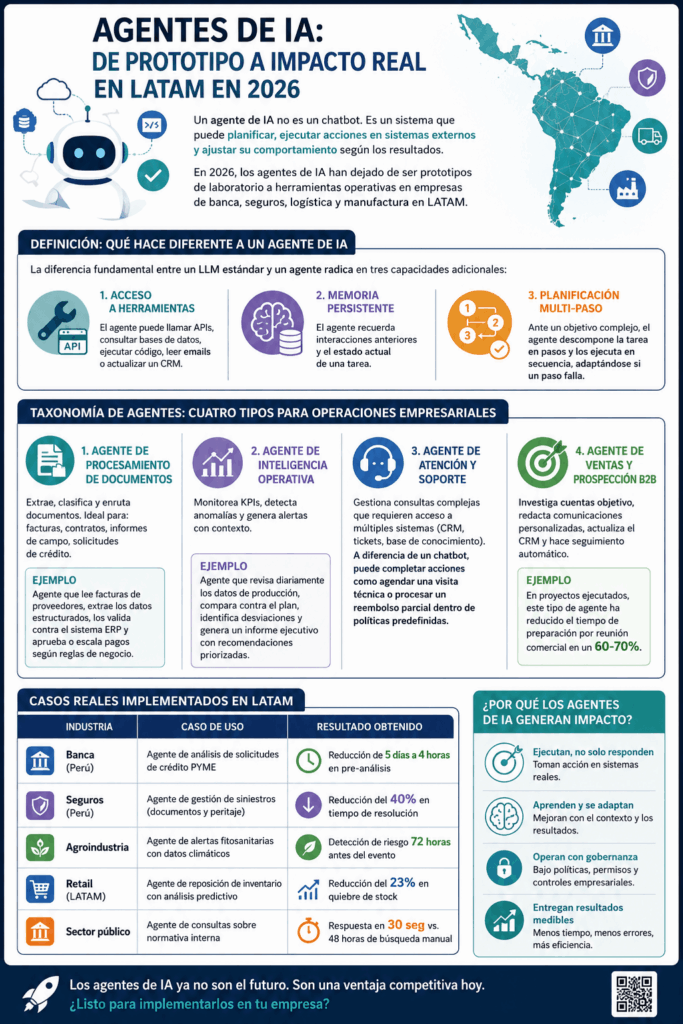
An AI agent is not a chatbot. It is a system that can plan, execute actions in external systems, and adjust its behavior based on results. In 2026, AI agents have moved from laboratory prototypes to operational tools in banking, insurance, logistics, and manufacturing companies across LATAM.
Definition: what makes an AI agent different
The fundamental difference between a standard LLM and an agent lies in three additional capabilities:
- Tool access: the agent can call APIs, query databases, execute code, read emails, or update a CRM.
- Persistent memory: the agent remembers previous interactions and the current state of a task.
- Multi-step planning: given a complex objective, the agent breaks the task into steps and executes them sequentially, adapting if a step fails.
Agent taxonomy: four types for business operations
Document processing agent
Extracts, classifies, and routes documents. Ideal for invoices, contracts, field reports, and credit applications. Example: an agent that reads supplier invoices, extracts structured data, validates it against the ERP system, and approves or escalates payments according to business rules.
Operational intelligence agent
Monitors KPIs, detects anomalies, and generates alerts with context. Example: an agent that reviews production data daily, compares it against the plan, identifies deviations, and generates an executive report with prioritized recommendations.
Customer service and support agent
Handles complex inquiries requiring access to multiple systems (CRM, tickets, knowledge base). Unlike a chatbot, it can complete actions such as scheduling a technician visit or processing a partial refund within predefined policies.
B2B sales and prospecting agent
Researches target accounts, drafts personalized communications, updates the CRM, and follows up automatically. In completed projects, this type of agent has reduced preparation time per sales meeting by 60-70%.
Real cases implemented in LATAM
| Industry | Use case | Result achieved |
| Banking (Peru) | SME credit application analysis agent | Reduction from 5 days to 4 hours for preliminary analysis |
| Insurance (Peru) | Claims management agent (documents and loss assessment) | 40% reduction in resolution time |
| Agribusiness | Plant health alert agent using climate data | Risk detection 72 hours before the event |
| Retail (LATAM) | Inventory replenishment agent with predictive analytics | 23% reduction in stockouts |
| Public sector | Internal regulations inquiry agent | Response in 30 seconds vs. 48 hours of manual searching |
Technical architecture: how an agent is built
An enterprise agent has five components that must be designed together:
- Core LLM (brain): receives the objective and decides which tools to use. Options: GPT-4o, Claude 3.7 Sonnet, Llama 3.3 70B.
- Tools: functions the agent can call. They are defined using a JSON schema and a natural-language description.
- Memory: conversational (the current thread), episodic (summaries of past interactions), and semantic (knowledge base).
- Orchestrator: manages execution flow, retries, and tool limits. LangGraph, AutoGen 0.4, and CrewAI are the most mature frameworks in 2026.
- Guardrails: safety rules the agent cannot violate. Critical in regulated environments.
When NOT to use an agent
Agents add complexity and failure points. They are not the right solution when:
- The task can be solved with a direct prompt to an LLM without access to external tools.
- The process requires human approval at every step (prefer workflows with an explicit human-in-the-loop).
- Errors in the agent's actions have irreversible consequences without supervision (large financial transactions, legal communications).
An 8-week implementation plan
- Weeks 1-2: Identify the target process, map the necessary tools, and define measurable success criteria.
- Weeks 3-4: Build and test each tool in isolation before integrating it into the agent.
- Weeks 5-6: Integrate the core LLM with the tools, design the system prompt, and perform adversarial testing.
- Week 7: Pilot with real users in supervised mode (human-in-the-loop for every action).
- Week 8: Review results, adjust guardrails, and decide whether to scale.
Sources
- Yao, S. et al. (2022). ReAct: Synergizing Reasoning and Acting in Language Models. arXiv:2210.03629.
- LangChain. (2026). LangGraph Documentation. langgraph.io
- Anthropic. (2025). Building Effective Agents — Updated best practices. anthropic.com/research/building-effective-agents