
AI for Operations Managers: 5 Real Cases from LATAM Companies
About this translation
Original publication dates and historical context are preserved. Images, embedded media, source documents and code examples remain in their original language.
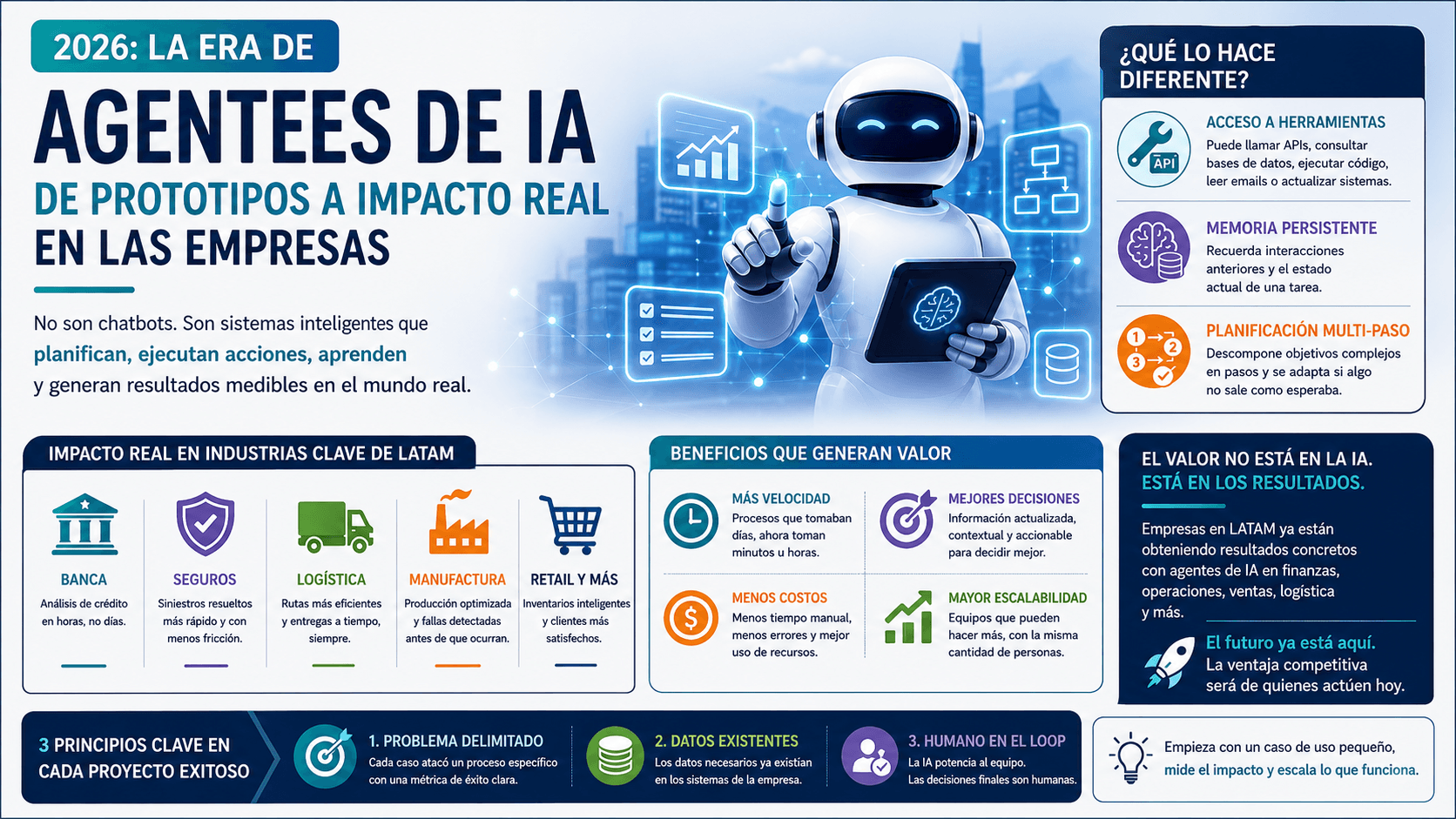
The biggest obstacle to AI creating value in a company is not technical. It is a matter of w: managers do not know what to ask AI, when to trust its results, or how to measure whether it is working. This article presents five real cases—implemented in Peruvian and Latin American companies—with concrete results that any manager can replicate.
Case 1: Reducing contract analysis time in procurement
Context
A retailer operating in three countries. The procurement team manually reviewed supplier contracts to check penalty clauses, pricing terms, and delivery deadlines. Average time per contract: 2.5 hours.
Implemented solution
A RAG system over the contract repository, combined with an extraction agent that generates a standardized summary of each contract with the 8 critical fields highlighted. The manager reviews the summary in 10 minutes and approves it or escalates it to the legal team.
Result
Analysis time fell from 2.5 hours to 12 minutes per contract. At a volume of 40 contracts per month, the savings amount to 87 hours of specialist work each month.
Case 2: Optimizing distribution routes with predictive AI
Context
An agribusiness company making daily deliveries to 180 retail outlets in Metropolitan Lima. Routes were planned using manual heuristics based on the dispatcher's experience.
Implemented solution
A route optimization model integrating historical traffic data, each customer's delivery windows, and each vehicle's capacity. The model suggests how to allocate orders to vehicles and the order of visits.
Result
An 18% reduction in kilometers traveled, a 12% reduction in fuel, and an improvement in delivery window compliance from 74% to 91% within 60 days of operation.
Case 3: Market intelligence assistant for the sales team
Context
A midsize bank. The business banking team prepared for client meetings by manually searching scattered sources (news, SBS reports, public financial statements). Preparation time per meeting: 3–4 hours.
Implemented solution
A research agent that, given a company's RUC tax ID or name, generates a one-page brief in 8 minutes containing: sector and competitive position, recent news, available public financial indicators, and signals of financial needs.
Result
Preparation time fell from 3.5 hours to 15 minutes. The sales team went from preparing 2 meetings per day to preparing 6. In the quarter following deployment, the meeting-to-proposal conversion rate increased by 22%.
Case 4: Early detection of operational risk at a plant
Context
A food processing plant. Unplanned downtime of critical equipment cost an average of USD 45,000 per incident in lost production and emergency repairs. Frequency: 3–4 incidents per quarter.
Implemented solution
An anomaly detection model using IoT sensor data (temperature, vibration, pressure, electricity consumption). The model issues alerts 6–18 hours before a probable failure, identifying the equipment, failure type, and urgency level.
Result
In the first 6 months, the system correctly anticipated 7 of 9 failures, with 2 false alarms. The project achieved ROI in its fourth month of operation.
Case 5: Automating management reports with generative AI
Context
A financial services company. The management control team spent 12–16 hours per month consolidating data from multiple departments and drafting the executive report for the board.
Implemented solution
An automated pipeline that extracts data from source systems, calculates KPIs, and produces a draft report with an executive narrative. The team reviews, adjusts, and approves the draft in 2 hours.
Result
Report preparation time fell from 14 hours to 2.5 hours. The report's narrative quality (rated by the board in a follow-up survey) improved from 6.8 to 8.4 out of 10.
What these five cases have in common
Three patterns recur in every successful project:
- A defined problem: none attempted to “implement AI” in a generic way. Each case addressed a specific process with a clear success metric established before starting.
- Existing data: none required new instrumentation from scratch. In every case, the necessary data already existed in the company's systems.
- Human in the loop: in no case did AI make final decisions without human review. The value lies in increasing the team's capacity, not replacing it.
How to identify the first use case for your company
The best starting point is a process with these characteristics: a high volume of repetitive tasks, a low percentage of exceptional cases, measurable results, and available historical data. Processes such as document classification, recurring report generation, and account analysis preparation usually meet all four criteria.
Sources
- McKinsey Global Institute. (2025). The state of AI in 2025: Generative AI breakout year. mckinsey.com/capabilities/quantumblack
- Gartner. (2026). Top Strategic Technology Trends for 2026. gartner.com/technology/research/top-technology-trends
- Cases documented in consulting projects by Erwin Salas Consulting Group S.A.C., 2023–2026.