
The 4 AI Standards Redefining How the Web Is Built (and Connected)
About this translation
Original publication dates and historical context are preserved. Images, embedded media, source documents and code examples remain in their original language.
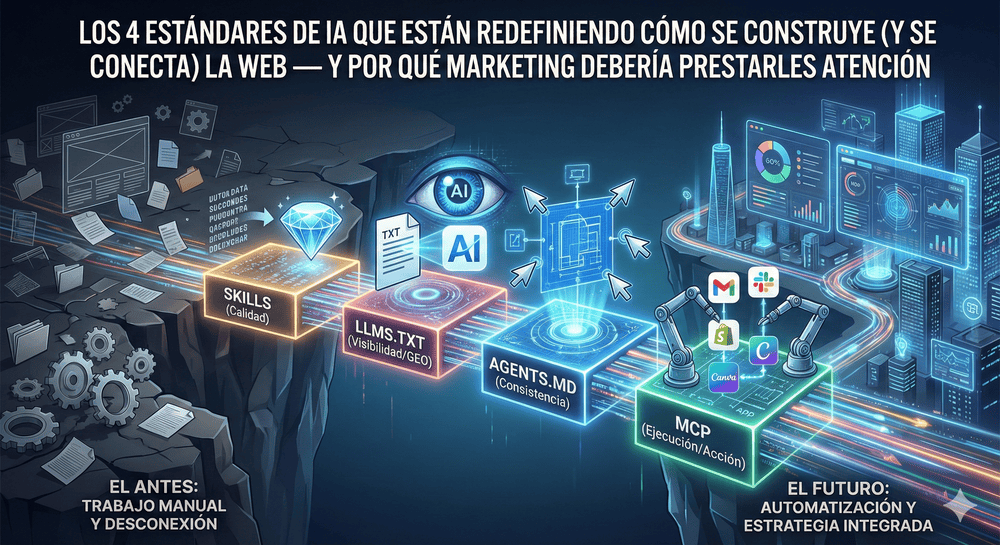
There is a technical conversation happening right now among development teams around the world, and it has direct consequences for how your brand appears in AI results, how quickly your team can launch digital products, and how much budget you need to automate operational workflows.
This is not about a specific tool or a passing fad. It is about four emerging standards being adopted simultaneously by all the major artificial intelligence platforms — from ChatGPT and Gemini to Claude and Cursor. If you are responsible for marketing in your organization, understanding these concepts will give you a real advantage in upcoming strategic conversations with technology, product, and executive leadership.
Let's go through them one by one.
1. Skills: expert instructions that transform what AI can do for you
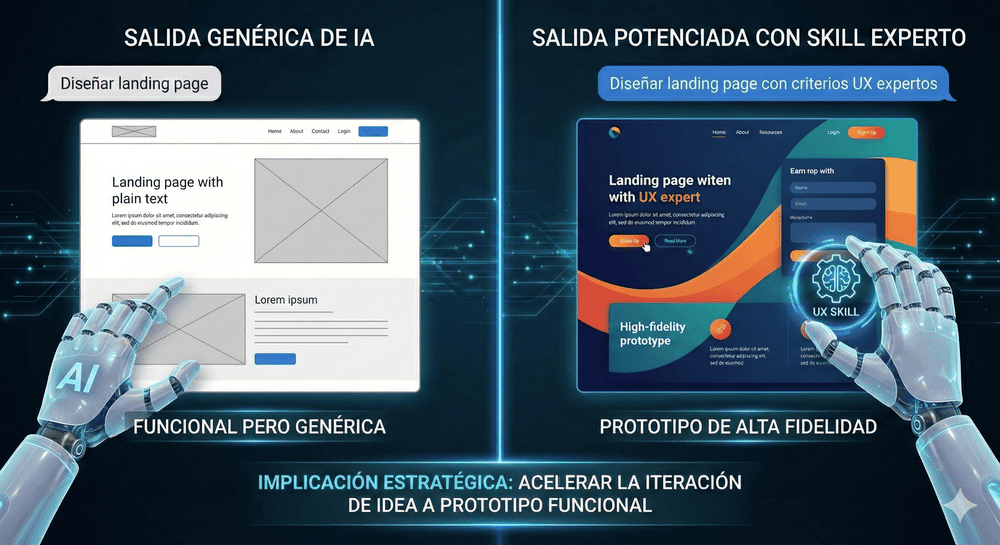
Imagine asking an AI to design the landing page for your next campaign. The result will be functional, yes, but probably generic: basic colors, standard typography, zero brand personality. Now imagine that before asking for that, you load a small file containing design criteria written by a UX expert: rules for spacing, visual hierarchy, color palettes, shadows, and microinteractions.
That is a skill: a set of specialized instructions that dramatically improve the quality of AI output, without you needing to be an expert in that domain.
What does this mean for marketing?
It means your team can produce high-fidelity prototypes, CRM database schemas, or even A/B testing structures with professional quality, simply by choosing the right skill. A public directory already exists — created by Vercel — where you can search for skills by category: frontend design, databases, code quality, and many more. And best of all: they are free.
The strategic implication is clear: the gap between “idea” and “working prototype” is shrinking to minutes. A marketing team that knows which skills exist can iterate on digital campaigns at a speed that previously required a full technical team.
2. llms.txt: the new “robots.txt,” but for artificial intelligence

If you work in digital marketing, you know the file robots.txt. It is that small file that tells Google how to crawl your website. Well, its equivalent for the AI era is emerging: the file llms.txt.
The logic is simple. When a language model (such as ChatGPT, Gemini, or Perplexity) needs to understand what your website is about, it currently has to “read” all the HTML: menus, buttons, icons, banners… an enormous volume of visual information that does not interest the model. All it needs to know is: What is this site about, what does it offer, and where is the relevant information?
The file llms.txt solves exactly that. It is a plain-text document you place at the root of your site that gives any AI a structured summary: who you are, what you do, your key sections, and where to find more information.
What does this mean for your marketing team?
This is GEO (Generative Engine Optimization) in its purest form. If your brand wants to appear correctly when someone asks an AI “Which company in Peru offers X service?”, having a llms.txt that is well constructed is like having a perfect business card ready for any AI model to read instantly.
Not having this file means leaving AI to interpret your site however it can, with all the visual noise of HTML. Having it means you are giving AI exactly the message you want it to convey about your brand. It is narrative control in the fastest-growing channel.
The full specification is at llmstxt.org, and implementation is surprisingly simple.
3. agents.md: the context file every AI tool already reads

When a development team works with AI tools to write code, each tool used to require its own context file: Claude read claude.md, Codex read codex.md, Gemini read gemini.md. A mess of duplicate files saying essentially the same thing.
The solution gaining traction is called agents.md: a single file that any AI tool recognizes as the “project manual.” It describes the technology stack, architecture, business rules, and key considerations the AI must respect whenever it interacts with the project.
What implications does this have for a marketing team?
More than it might seem. This file is, essentially, the digital project's source of truth. If your marketing team works with development to build an e-commerce site, an app, or a portal, the agents.md is where the rules of the game are documented: what technology is used, how it is organized, and what must not be touched.
The practical implication is that if your company already uses AI tools to develop digital products — and more and more companies do — this file ensures consistency. It does not matter whether you change tools, vendors, or technical teams tomorrow: the project's context travels with the project, not with the people.
This reduces errors, accelerates onboarding, and, above all, protects the development investment that marketing often drives.
4. MCP (Model Context Protocol): when AI stops answering and starts executing

This is probably the standard with the greatest immediate impact on a marketing department. MCP stands for Model Context Protocol and addresses something that until recently was operational science fiction: AI not only tells you what to do but does it for you, connecting directly to your tools.
Which tools? Gmail, Google Drive, Google Calendar, Slack, Notion, Stripe, PayPal, Shopify, GitHub, ClickUp, WordPress, Canva… the list grows every week.
In practice, this means an AI agent can read and reply to your emails, organize files in Drive, create presentations in Canva, manage tasks in Notion, deploy changes to your website, and even connect to your database to generate reports — all autonomously, through what are called MCPs.
What does this mean for marketing?
Think of your most repetitive operational workflows: consolidating weekly reports, updating dashboards, sending summaries to stakeholders, creating briefs from data, moving tasks between management platforms. All of that can already be automated through MCPs without complex development.
The company that started this standard was Anthropic (the creator of Claude), but today ChatGPT, Gemini, Cursor, and practically every major AI platform already support it. In other words, you are not betting on a single provider — you are adopting a universal protocol.
The medium-term vision is that every SaaS platform your team uses will have its own MCP, enabling an AI agent to operate as an assistant that actually executes tasks across all your tools, from end to end.
The full picture: why these 4 standards matter together
Seen in isolation, each standard looks like a technical detail. Seen together, they outline a paradigm shift in how digital products are built and operated:
| Standard | What it solves | Impact on Marketing |
|---|---|---|
| Skills | Improves AI output quality with expert knowledge | High-quality prototypes and digital assets, faster |
| llms.txt | Tells AIs what your website is about | Control over how your brand appears in AI answers (GEO) |
| agents.md | A single context file for all AI tools | Consistency in digital projects, less dependence on individuals |
| MCP | Connects AI to real tools to execute actions | Real automation of marketing operational workflows |
There is one underlying message: AI is no longer just a chatbot that answers questions. It is an operational layer being integrated across the entire digital infrastructure. And these four standards are the rails on which that integration is happening.
A marketing leader who understands this does not need to write code. They need to know which questions to ask, what to request from their technical team, and how to prioritize adoption of these standards so their department is not left waiting in the IT queue.