
GEO vs. SEO: Differences, Complementarity, and How to Master Both in 2026
About this translation
Original publication dates and historical context are preserved. Images, embedded media, source documents and code examples remain in their original language.
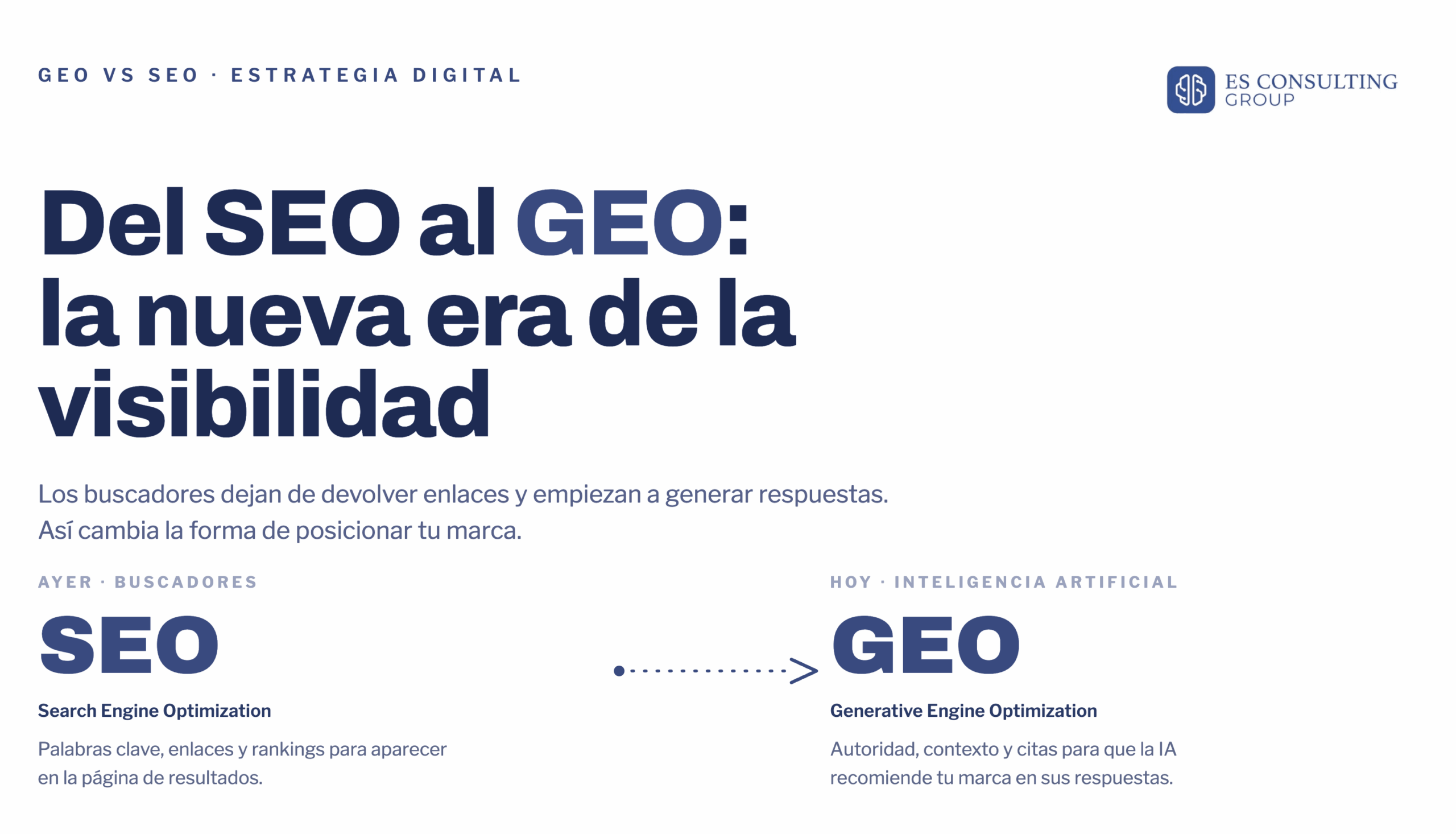
In 2023, global organic traffic began to decline in categories where Google AI Overviews (formerly SGE) provides direct answers. In 2026, the question is no longer whether to adapt your content strategy to AI engines, but how to do so without abandoning the traditional SEO that continues to generate traffic. This article explains the technical differences between GEO and SEO, and how to build a strategy that works in both ecosystems.
What is GEO (Generative Engine Optimization)?
GEO is the discipline of optimizing content so that generative AI models
In 2023, global organic traffic began to decline in categories where Google AI Overviews (formerly SGE) provides direct answers. In 2026, the question is no longer whether to adapt your content strategy to AI engines, but how to do so without abandoning the traditional SEO that continues to generate traffic. This article explains the technical differences between GEO and SEO, and how to build a strategy that works in both ecosystems.
What is GEO (Generative Engine Optimization)?
GEO is the discipline of optimizing content so that generative AI models (ChatGPT, Perplexity, Google AI Overviews, Claude) cite, summarize, or recommend it when a user asks a question. Unlike traditional SEO, the goal is not to appear in a list of results, but to be the source the model selects to construct its answer.
Technical differences between GEO and SEO
| Dimension | Traditional SEO | GEO |
| Primary objective | Ranking in results (positions 1-10) | Being cited in AI-generated answers |
| Processing engine | Google's crawler (Googlebot) | LLMs: GPT-4, Gemini, Claude, Perplexity |
| How success is measured | Position, CTR, organic clicks | Mentions in AI answers, AI referral traffic |
| Primary authority signal | Backlinks + PageRank | Citations in high-authority sources + factual consistency |
| Preferred content format | Long pages with keywords | Concise, well-structured, citable answers |
| Speed of impact | 3-6 months for visible results | 2-8 weeks in some models |
| Tracking tools | Search Console, Ahrefs, Semrush | Brandwatch, Perplexity monitoring, llms.txt analytics |
Why GEO and SEO are complementary, not alternatives
A common mistake is to treat GEO as a replacement for SEO. The data does not support that conclusion: in May 2026, Google still processes more than 9 billion searches daily, despite the growth of Perplexity and other AI engines. AI answers have not eliminated search; they have added a new discovery channel. The right strategy optimizes for both:
- Content that is well structured for SEO (clear H1-H6 headings, short paragraphs, lists) is also what LLMs extract most easily.
- The domain authority you build with SEO (backlinks, academic citations, press mentions) also informs the models' perception of your credibility.
- GEO traffic is incremental: users who would have resolved their query without clicking any result can now reach your site from an AI answer.
Signals LLMs use to select sources
Based on research by Stanford HAI (2024) and my own experiments with Perplexity, ChatGPT, and Claude, the signals that increase the likelihood of being cited are:
- Domain authority: sites with high PageRank and academic citations carry greater weight.
- Factual consistency: content that aligns with what the model already knows (prior training) is selected more frequently.
- Explicit structure: descriptive headings, lists, tables, and clear definitions make model extraction easier.
- Information freshness: for changing topics, recently updated content has an advantage.
- Specificity: precise answers to specific questions outperform generic content for that type of query.
llms.txt: the file LLMs can read
The llms.txt protocol (proposed by Jeremy Howard, fast.ai, 2024) is a text file in a website's root directory that tells LLMs which pages are relevant, what the most important content is, and how to cite the author. It is the equivalent of robots.txt, but for language models rather than crawlers.
Adoption remains low (around 5% of sites with significant traffic in May 2026), which continues to represent a first-mover advantage for those who implement it correctly. For erwinsalas.com, implementing llms.txt is a high-impact, low-effort action.
An integrated GEO + SEO strategy: the 8 actions
- Audit existing content to identify pages with high potential for AI citations (direct answers to frequently asked questions).
- Rewrite introductions to key articles so that the first answer to the question appears within the first 100 tokens.
- Add explicit definitions of key terms in each article (LLMs prioritize clear definitions).
- Implement llms.txt on the domain, pointing to the most relevant pages.
- Publish on platforms LLMs prioritize: Reddit, LinkedIn Pulse, Substack, academic publications.
- Build citations in high-authority sources: interviews in specialist media, mentions in industry reports.
- Monitor domain mentions in Perplexity and ChatGPT answers with monthly searches for target keywords.
- Maintain your technical SEO strategy: Core Web Vitals, data structure, loading speed.
Sources
- Aggarwal, S. et al. (2023). GEO: Generative Engine Optimization. arXiv:2311.09735. Princeton & Georgia Tech.
- Howard, J. (2024). llms.txt proposal. llmstxt.org
- Google. (2026). AI Overviews: guidance for site owners. developers.google.com/search/docs/appearance/ai-overviews
- Stanford HAI. (2025). AI Index Report 2025. aiindex.stanford.edu
, Perplexity, Google AI Overviews, Claude) cite, summarize, or recommend it when a user asks a question. Unlike traditional SEO, the goal is not to appear in a list of results, but to be the source the model selects to construct its answer.
Technical differences between GEO and SEO
| Dimension | Traditional SEO | GEO |
| Primary objective | Ranking in results (positions 1-10) | Being cited in AI-generated answers |
| Processing engine | Google's crawler (Googlebot) | LLMs: GPT-4, Gemini, Claude, Perplexity |
| How success is measured | Position, CTR, organic clicks | Mentions in AI answers, AI referral traffic |
| Primary authority signal | Backlinks + PageRank | Citations in high-authority sources + factual consistency |
| Preferred content format | Long pages with keywords | Concise, well-structured, citable answers |
| Speed of impact | 3-6 months for visible results | 2-8 weeks in some models |
| Tracking tools | Search Console, Ahrefs, Semrush | Brandwatch, Perplexity monitoring, llms.txt analytics |
Why GEO and SEO are complementary, not alternatives
A common mistake is to treat GEO as a replacement for SEO. The data does not support that conclusion: in May 2026, Google still processes more than 9 billion searches daily, despite the growth of Perplexity and other AI engines. AI answers have not eliminated search; they have added a new discovery channel. The right strategy optimizes for both:
- Content that is well structured for SEO (clear H1-H6 headings, short paragraphs, lists) is also what LLMs extract most easily.
- The domain authority you build with SEO (backlinks, academic citations, press mentions) also informs the models' perception of your credibility.
- GEO traffic is incremental: users who would have resolved their query without clicking any result can now reach your site from an AI answer.
Signals LLMs use to select sources
Based on research by Stanford HAI (2024) and my own experiments with Perplexity, ChatGPT, and Claude, the signals that increase the likelihood of being cited are:
- Domain authority: sites with high PageRank and academic citations carry greater weight.
- Factual consistency: content that aligns with what the model already knows (prior training) is selected more frequently.
- Explicit structure: descriptive headings, lists, tables, and clear definitions make model extraction easier.
- Information freshness: for changing topics, recently updated content has an advantage.
- Specificity: precise answers to specific questions outperform generic content for that type of query.
llms.txt: the file LLMs can read
The llms.txt protocol (proposed by Jeremy Howard, fast.ai, 2024) is a text file in a website's root directory that tells LLMs which pages are relevant, what the most important content is, and how to cite the author. It is the equivalent of robots.txt, but for language models rather than crawlers.
Adoption remains low (around 5% of sites with significant traffic in May 2026), which continues to represent a first-mover advantage for those who implement it correctly. For erwinsalas.com, implementing llms.txt is a high-impact, low-effort action.
An integrated GEO + SEO strategy: the 8 actions
- Audit existing content to identify pages with high potential for AI citations (direct answers to frequently asked questions).
- Rewrite introductions to key articles so that the first answer to the question appears within the first 100 tokens.
- Add explicit definitions of key terms in each article (LLMs prioritize clear definitions).
- Implement llms.txt on the domain, pointing to the most relevant pages.
- Publish on platforms LLMs prioritize: Reddit, LinkedIn Pulse, Substack, academic publications.
- Build citations in high-authority sources: interviews in specialist media, mentions in industry reports.
- Monitor domain mentions in Perplexity and ChatGPT answers with monthly searches for target keywords.
- Maintain your technical SEO strategy: Core Web Vitals, data structure, loading speed.
Sources
- Aggarwal, S. et al. (2023). GEO: Generative Engine Optimization. arXiv:2311.09735. Princeton & Georgia Tech.
- Howard, J. (2024). llms.txt proposal. llmstxt.org
- Google. (2026). AI Overviews: guidance for site owners. developers.google.com/search/docs/appearance/ai-overviews
- Stanford HAI. (2025). AI Index Report 2025. aiindex.stanford.edu